Armbian release 26.8


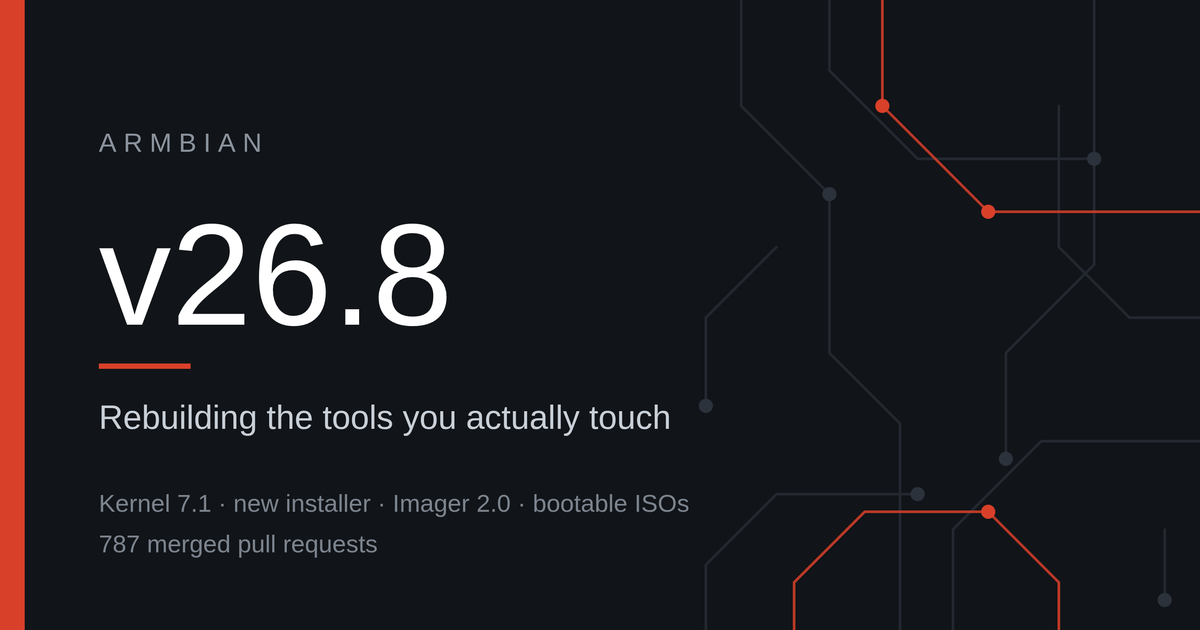
Rebuilding the tools you actually touch
Kernel 7.1 across the tree, a rewritten installer, Imager 2.0, and UEFI ISO images
Three rewrites in one cycle
Most releases are a long list of small improvements. This one had three larger pieces landing at roughly the same time, and all three touch parts of Armbian that people use directly rather than parts they only read about in changelogs.
The installer was rewritten. Armbian Imager reached 2.0. And our CI moved out of the repository it had outgrown into one built for the job. None of these were planned to coincide; they simply reached the point where postponing them again would have cost more than doing them.
The installer rewrite is the one I expect people to notice first. It now ships as an armbian-config module, which means it is unit-tested, the same way the rest of armbian-config is tested, rather than living as a script that everyone was slightly afraid to touch. It can target SPI and MTD, treats eMMC and NVMe as separate flows instead of pretending they are the same thing, can flash a bootloader on its own, and — this one is overdue — reports when a bootloader write fails instead of printing "Done." and leaving you to find out at the next boot.
As always, every image in this release was manually validated for basic functionality. The automation keeps improving, but a board that boots in CI and a board that boots on a desk are still two different things.
Igor
Project Manager
Changes overview
This release advances on three fronts: kernel and firmware baselines moved forward across the entire tree, the tooling around installing and writing images was rebuilt, and the build and CI infrastructure was restructured onto Debian Trixie with a weekly stable cadence.
Kernels and firmware
Mainline support moves to 7.1 stable, with 7.2 available on edge branches for rockchip64, meson64, mvebu64, sunxi and bcm2711. U-Boot went to v2026.07 across most of boards, including the Rockchip RK35xx family, Amlogic, i.MX6, and the mvebu.
A number of long-carried patches were finally dropped this cycle because upstream fixed them properly — the 8250 DMA reopen crash, the SysRq-via-BREAK handling, several sunxi and meson64 patches. Carrying fewer patches is not a headline feature, but it is what makes the next kernel bump cheaper than the last one.
Wireless driver cleanup
The rtl8852bs, rtl8189es, rtl8192eu and uwe5622 drivers now live in dedicated Armbian repositories, build against up to 7.2, and are several thousand compiler warnings quieter than they were in June. That work was not cosmetic: going through the warnings surfaced a use-after-free in the uwe5622 probe path, a NULL dereference on efuse allocation failure, a leaked path reference, and a handful of unbounded copies in ioctl handlers. Vendor Wi-Fi blobs have been the least-inspected code in the tree for years. They are meaningfully less so now.
Incoming hardware
New this cycle: Anbernic RG DS and RG Vita Pro, Radxa Cubie A7Z and Dragon Q6A/Q8B, Seeed reComputer RK3576 and RK3588 DevKits, TI BeagleBadge and TMDS64EVM, Orange Pi 4 Pro and Zero 3W, Sovol Zero and SV08, Walnut Pi Box and 1B, EmbedFire LubanCat 5IO, LuckFox Nova, SpacemiT K3 Pico-ITX, Milk-V DuoS, Avnet MaaXBoard 8ULP, NanoPi NEO3 Plus, KICKPI K3B, Graperain G3568 v2, EASY EAI Nano, Mellow Fly C5, CIX P1, Xiaomi Pad 6S Pro and Tanix TX6S. Fourteen existing boards were promoted to standard support, a few dropped to community support, and Banana Pi R2 came back from the dead on 6.18.
Imager and image formats
Armbian Imager 2.0 adds QDL and UFS flashing for Qualcomm targets, pulls the board registry from the Armbian API rather than shipping a copy that goes stale, and enumerates devices more carefully on both Windows and Linux.
UEFI images can now be built as bootable live ISOs through the new image-output-iso extension. This makes Armbian directly usable over IPMI virtual CD and in cloud environments where an ISO is the only accepted input. The download and redirector infrastructure was extended to carry those ISOs alongside the compressed raw images.
Build framework and CI
CI moved out of armbian/os into its own armbian/ci repository. Runners register through NetBox, each one carrying its own proxy and cache export configuration, and a watchdog automatically retries runs killed by stalled runners rather than leaving a red cross for someone to notice in the morning. Stable builds now run weekly.
The default build host and Docker base image are Debian Trixie, which forced a long tail of fixes to older U-Boot trees against GCC 14 and SWIG 4.3 — the kind of work that is invisible when it succeeds. riscv64 images are now generated natively, and kernel patch rewriting runs in parallel with stricter From-header hygiene.
Every board, every promotion and every one of the 787 merged pull requests is listed in the release notes.
Thank you
787 pull requests went into this release, from long-standing team members and from people who showed up once to fix a device tree on a board nobody else owns. Both matter. The wireless cleanup in particular was one contributor deciding that thousands of warnings were worth working through, one file at a time.
And to our partners and donors — hardware, infrastructure, engineering time, and money — thank you. The infrastructure work in this release is expensive in exactly the way that is hard to fundraise for, and it happened because you make it possible.